This economy already has its flagship success stories; Airbnb, Blablacar, Guesttoguest, and Drivy are all successful companies well known to the general public. In just a few years, it has built a global market worth $15 billion, and the most knowledgeable observers estimate that it will reach $335 billion by 2025, following annual growth of nearly 40%! It sparks heated debate because, while some see it as leading to intolerable job insecurity, others hail this new economy as a solution to the challenges of our time—unemployment in particular. It poses a headache for our policymakers, as our legislation is ill-suited to it. It’s fun, new, and puts the individual at the center of relationships, prioritizing trust over formalities. Everyone knows about it; many of us have tried it; some have even become hooked on it. But what exactly is the sharing economy?
One good consumed instead of two, but two needs met instead of one!
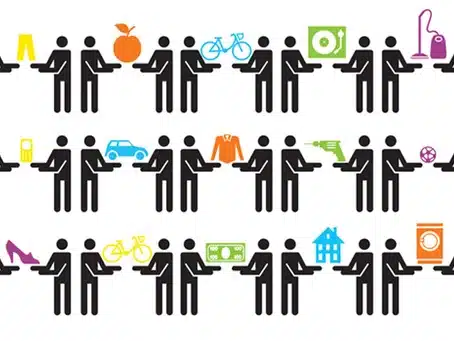
It was in 2000 that the idea of a different kind of economy, based on the concept of sharing, emerged in the United States under the name “sharing economy.” For its pioneers, the goal was to combat the depletion of resources, resulting in particular from rapid population growth. For them, the solution lay in sharing underutilized assets. Everyone has assets (a car, a boat, a house, etc.) that they don’t use, or use only rarely; so, rather than an individual purchasing a new item that they will use only partially themselves, it is better for them to use a third party’s underutilized asset. Only one good will be consumed instead of two, but ultimately, two needs will have been met instead of one! Furthermore, this new way of thinking about economic relationships responds to a certain “disenchantment” with the traditional capitalist system, to a desire to move away from impersonal, long-established networks, and to stop relying on traditional intermediaries—namely, very large corporations. Resource conservation on a macro level, spending control on a micro level, and strengthened social bonds… The idea was brilliant! However, for the story to begin, the concept still needed to be refined, and a few challenges had to be resolved, namely: How can one person know that another has the asset they need—and, moreover, that—since they are only using it part-time—they are willing to share it? It is therefore not just a matter of pooling resources to save money, but rather of finding a way to network them; since we have already entered the digital age, the Marketplace is a connected, collaborative platform. – While the goal is certainly to share, not to engage in a for-profit activity, it is essential that the provider see a benefit in this sharing; otherwise, the idea won’t work. Therefore, the system will be based on the concept of cost-sharing. The provider will receive compensation for the asset they own and agree to share, but this will constitute only a contribution toward the costs associated with that asset—and under no circumstances a profit. Thus, we share not only an asset but also the costs related to it. – To rethink the act of consumption and break free from traditional intermediation networks controlled by large corporations, people must transact directly, without the intervention of a third party—particularly regarding the amount of compensation paid to the provider. Over-the-counter transactions will thus be the norm, and the principle of “intuitu personae” will regain its prestige in this economy.
A System Based on Trust
– Finally, for this to work, trust is essential. Without trust, the sharing economy cannot function. In this system, relationships are not organized by a company that controls or secures them; similarly, governments are not intended to intervene directly, particularly through specific legislation. Participants must therefore trust the system.
To address this issue, one quickly thinks of a system in which participants indirectly monitor one another, particularly by expressing their satisfaction or dissatisfaction following the completion of a transaction.
It is largely through these user reviews that good members will be recognized and bad ones weeded out.
In short, it is through a form of self-regulation that trust can be fostered within the community.
Based on these various elements, we can ultimately define the sharing economy—at least in its “purest” form—quite simply.
It consistently involves:
– A platform that connects a person with a need to a person who can meet that need, thanks to an asset they own but only partially utilize.
– A community of users who pool resources and trust one another—particularly through the reviews they leave for one another—which helps rid the community of unscrupulous members.
– Peer-to-peer relationships free from third-party intervention, resulting in the sharing of an asset by its owner in exchange for compensation; this compensation, while freely negotiated by the parties, must be based on cost-sharing, and not a for-profit commercial activity.
This is what the collaborative economy—the sharing economy—is, as it was “originally” conceived, and as it is actually implemented by certain companies that operate platforms.
Let’s take the example of the ride-sharing sector, whose market leader is well known to everyone and which serves as an excellent illustration of an activity in the collaborative economy. It involves, quite simply, the operation of a platform where people who want to travel can connect with others who have an underutilized asset—namely, a vehicle that is half, one-third, or one-quarter full during their daily commutes.
These individuals negotiate directly with one another the practical details of sharing the asset (meeting place, route, etc.), as well as the financial terms—namely, the proportion in which the rider will contribute to the costs incurred by the driver for the trip. Afterward, both parties can share their feedback to help build trust among community members. We will see in future posts that the sharing economy has already undergone changes that may lead to models quite different from the original concept.
 Liability and Contract Law
May 14, 2020