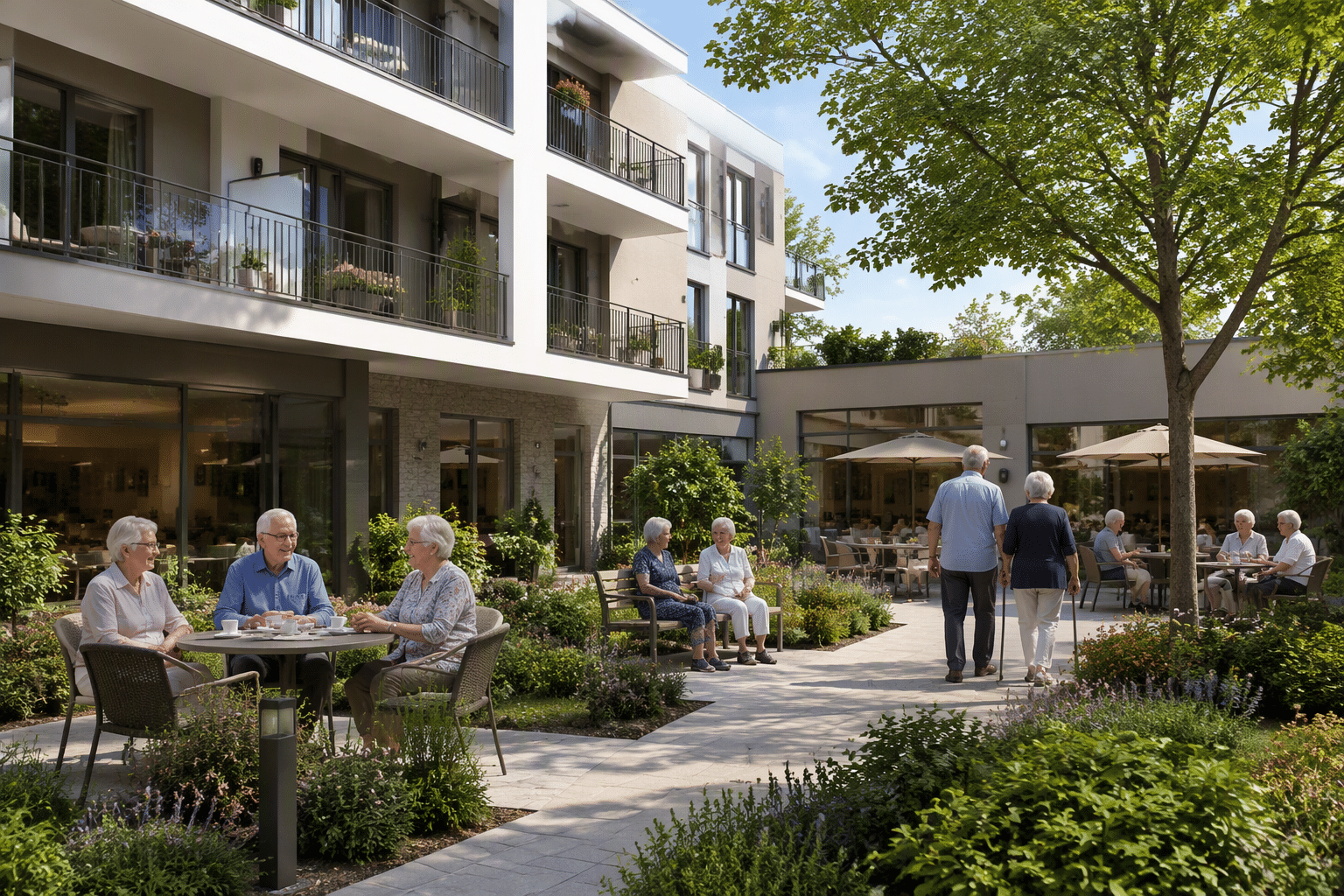
The senior housing sector is undergoing a period of profound readjustment. This crisis does not mean that the needs associated with an aging population have disappeared. Rather, it reveals the limitations of a model that developed very rapidly, sometimes based on overly optimistic assumptions regarding real estate prices, occupancy rates, guaranteed rents, and rental profitability.
First, it is important to distinguish between senior service residences—designed for independent seniors—and independent living facilities and nursing homes (EHPADs), which operate under different social, medical-social, and regulatory frameworks. In a senior service residence, three parties typically coexist. The property owner is often a private investor, the resident is a tenant, and the operator manages the residence and the services provided to the residents. In particular, the operator bears the risk associated with marketing the units and dealing with vacancies. 1
A Rapidly Expanding Market
The French housing stock has grown rapidly in recent years. According to the SILVITA Observatory, France had approximately 1,338 senior assisted living facilities in operation by the end of 2025, representing 108,286 units. An interministerial report published in 2026 cites figures of a similar magnitude, with 1,348 residences and 109,249 housing units. The differences stem primarily from variations in the scope and methods of data collection. 2
This growth has been driven by several factors. Demographic aging creates a sustained demand for housing that is adapted, secure, and equipped with services. The majority of older adults wish to remain in a standard residential setting while benefiting from greater security, social interaction, and assistance. The Directorate General for Enterprise estimates that France had 18.6 million people over the age of 60 in 2023 and could have 20.8 million by 2030. 3
The sector also benefited from the marketing of housing units to individual investors. The structure frequently involved an off-plan purchase, bank financing, a commercial lease with the operator, and the prospect of regular rental income. This presentation helped establish senior living facilities as a relatively safe real estate investment, even though performance actually depended on the operator’s financial health and the facility’s ability to break even.
An Economic Equation That Has Become Much More Challenging
The primary cause of this vulnerability stems from rising costs. Land, construction, renovations, energy, insurance, and personnel expenses have increased, while residents’ ability to absorb rate hikes remains limited. Senior living facilities must, in fact, offer a wide range of services and maintain a significant staff presence. Their profitability therefore depends not only on the value of the buildings themselves, but also on the balance between rent, billed services, and operating costs.
Rising interest rates subsequently worsened financing conditions. They increased the cost of debt for developers and operators and reduced the value of real estate assets. They also made investing in senior living communities less attractive compared to other asset classes. As early as 2024, BNP Paribas Real Estate had already identified the cumulative effect of rising land prices, construction costs, borrowing rates, and the compression of yields. 4
The investment market illustrates this reversal. According to Newmark, investment in senior assisted living facilities in 2025 totaled approximately 202 million euros. The consulting firm believes that the fundamentals of this asset class appear less solid than those of student housing and notes that investment levels are below the average for the past five years. 5
A Supply That Is Sometimes Too Standardized
The rapid growth of the housing stock has also led to a concentration of supply in certain regions and a standardization of concepts. Residences have sometimes been developed based on theoretical demand, without a sufficiently detailed analysis of local purchasing power, competition, residential habits, and the catchment area’s ability to sustainably support the facility over the long term.
The interministerial task force dedicated to housing models adapted to aging specifically highlights the risk of an overly standardized supply and emphasizes the need to better tailor services to the actual needs of older adults. It also emphasizes that the development of senior housing must meet objectives of affordability and quality of care. 6
This issue is central. A retirement community can be technically sound and well-located yet still face difficulties if its rents and service fees are too high. The sector is therefore facing a structural contradiction. It must offer common areas, dining options, recreational activities, security, and a human presence, while remaining accessible to retirees whose incomes vary widely.
Operators’ Challenges at the Heart of the Crisis
The real estate crisis turns into an operational crisis when retirement communities fail to achieve a sufficient occupancy rate or when their fixed costs become too burdensome. In this model, costs are largely inelastic. Even a partially occupied residence must maintain a portion of its staff, equipment, maintenance contracts, and essential services.
The difficulties faced by Réside Études Seniors served as a significant wake-up call. The operator of the Les Girandières and Palazzo brands, which managed 72 residences and housed several thousand residents, was placed in receivership in June 2024 following a safeguard proceeding initiated in December 2023. The situation raised serious concerns for residents, employees, landlords, and creditors. 7
This episode served as a reminder that a commercial lease does not economically guarantee the operator’s long-term viability. When the operator encounters difficulties, landlords may face unpaid rent, lease renegotiations, exceptional service charge calls, or the need to find a new operator. The operator’s failure can also affect the continuity of services and the residence’s reputation.
A Crisis Affecting Several Stakeholder Groups
Developers are affected by declining sales and rising development costs. Operators are facing rising costs and pressure on rates. Individual investors are finding that the projected profitability depends heavily on the financial strength of the tenant. Residents, for their part, may face reduced services, higher fees, or uncertainty regarding the continuity of operations.
The crisis thus reveals a disconnect between real estate ownership and service operations. The owner owns an apartment, but the economic value of that apartment depends largely on the existence of an operator capable of maintaining an attractive business. In residential complexes with multiple investors, coordination among the owners, the property manager, the lessor of the common areas, and the operator can become particularly complex.
The risk is heightened when contractual rents have been set at a level higher than the operation’s actual capacity. The commercial lease can then become a source of rigidity. The operator must bear a predetermined rental burden, while its revenue depends on occupancy rates and residents’ ability to pay for services. This tension can lead to requests for renegotiation, rent waivers, or bankruptcy proceedings.
A Sector That Remains Necessary but Must Change Its Business Model
The crisis does not mean that senior living facilities do not meet any needs. It shows that their development must be better calibrated. Demographic aging, the desire to remain at home, and the demand for adapted housing are enduring trends. The Directorate General for Enterprises, in fact, anticipates a significant increase in the need for personal care services by 2030. 3
The sector’s future will likely depend on several developments. Operators will need to prioritize establishing facilities based on local demand rather than solely on land availability. Residences will need to offer more flexible layouts, customizable services, and rates tailored to different income levels. Models that integrate in-home services, partnerships with local governments, healthcare professionals, and nonprofit organizations could also gain traction.
The issue of affordability will become crucial. A senior living facility cannot rely exclusively on a wealthy clientele if it aims to address a broader policy challenge related to aging. The interministerial report published in 2026 further recommends developing a diversified range of options, strengthening shared housing, and directing public funding toward financially accessible solutions. 6
Conclusion
The crisis in senior living facilities is, above all, a crisis of business model and governance. It stems from a combination of rapid expansion, more expensive real estate financing, rising operating costs, a sometimes standardized offering, and excessive reliance on the financial strength of operators.
The sector nevertheless has significant potential, as it addresses an undeniable demographic shift. The period ahead is likely to be one of project selection and operator consolidation. The most robust retirement communities will be those that combine a strategic location, services that residents actually use, sustainable pricing, a prudent financial structure, and clear governance among owners, operators, and residents. The focus will therefore no longer be on building more and more, but on building and operating senior living facilities that are truly tailored to the needs and resources of older adults.
Sources
- Rental Assisted Living Facilities – ANIL • www.anil.org
- www.capresidencesseniors.com • https://www.capresidencesseniors.com/docs/pu/1/27032026observatoire-silvita-des-residences-seniors-mars-2026.pdf
- Studies and Data on Personal Services | Personal Services (SAP) • www.servicesalapersonne.gouv.fr
- REAL ESTATE INVESTMENT: SLOWDOWN IN THE SENIOR LIVING MARKET IN FRANCE – BNP Paribas Real Estate Pressroom • presse.realestate.bnpparibas.fr
- eussa01corpweb.blob.core.windows.net • https://eussa01corpweb.blob.core.windows.net/nmrkweb/uploads/documents/HD_March%C3%A9-R%C3%A9sidentiel-Investissement-France_Newmark-Janvier-2026.pdf
- Ministry of Ecological Transition and Territorial Cohesion: Inter-inspection Task Force on Various Forms of Shared Housing Adapted to Aging • portail.documentation.developpement-durable.gouv.fr
- Client Challenge • www.lemonde.fr