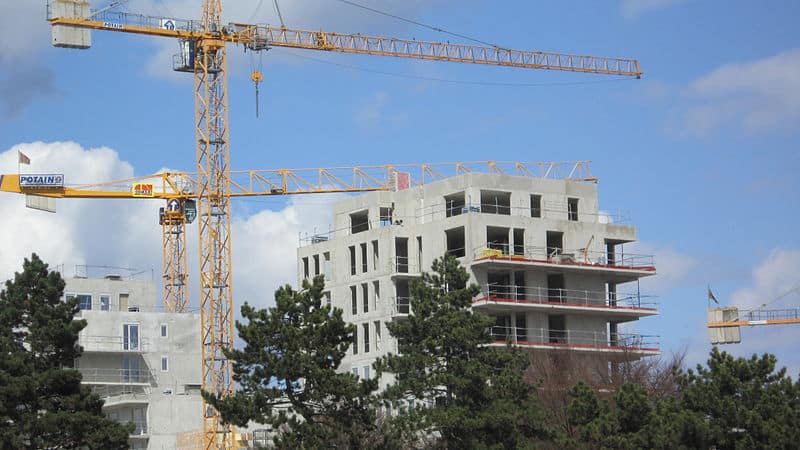
Buildings under construction in Strasbourg (67). Credit: Laurent Jerry.
Commentary on the ruling of the Court of Cassation, Civil Chamber 3, May 23, 2019, 17-17.908 [1]:
The Act of January 3, 1967, relating to the sale of real estate under construction (VEFA), initially pursued two objectives:
First, to establish regulations governing the sale of future real estate, with the introduction of the VEFA framework setting forth the relevant principles.
And second, to implement a set of special measures aimed at providing enhanced protection for the buyer, the “protected sector,” which applies whenever the properties to be built are for residential or mixed-use purposes and whose purchase requires the payment of a sum of money prior to completion.
Traditionally, case law held that buildings intended for tourist or hotel use were excluded from the protected sector. Purchasing a unit in such residences—where the buyer leases the property under a commercial lease—was considered to fall outside the protected sector [2].
However, the courts’ position on this issue has evolved since 2016. Indeed, in a series of rulings dated January 7, 2016 [3], the High Court, in a case involving a renovation project for a building intended to become a senior living facility, ruled that the rules governing the protected sector (set forth in Articles L. 261-10 et seq. of the Construction and Housing Code) apply to the transaction after noting “that the deeds of sale involved the transfer of ownership of units in a building, that the renovation work had not been completed as of the date of sale, and that the purchasers had paid the purchase price in full in the days following the saleand found that the units sold were furnished apartments intended as primary residences, each with a shower room, toilet, and kitchen, intended to be occupied year-round by elderly individuals, […].’
In the case decided on May 23, 2019, which is of interest to us here, the Court of Cassation follows this line of case law.
“The issue is clear: whether or not the ‘protected sector’ applies to the situation.”
In fact, an individual purchased units in a building undergoing renovation. The purpose of the project was to create a hotel-style residence that would allow its beneficiaries to engage in a tax-sheltering strategy through professional furnished rentals. The construction project was ultimately abandoned.
The seller and the general contractor were placed in judicial liquidation, and the buyer sought to hold the notaries involved in the sale liable.
In the buyer’s view, the notaries failed in their duty to advise by refraining from offering him the option of repeating the sale under the protective framework of a sale of a property under construction.
The issue at stake is clear: whether or not the “protected regime” applies to the situation.
Following a case-by-case assessment, the appellate court held the notaries liable on the grounds of the loss of opportunity suffered by the buyer.
In the case at hand, the Court of Cassation reiterates its 2016 position and upholds the Court of Appeals’ ruling:
“Having found that a preliminary reservation agreement referred to the sale of a two-room duplex with the establishment of a condominium, whereas the notarized deed stipulated that the purchased premises were for residential useresidential use, and having correctly held that the terms governing the management of this property—or the building to which it belonged—as a hotel residence were irrelevant, a court of appeals rightly concluded that the protective regime governing off-plan sales provided for in Article L. 261-10 of the Construction and Housing Code was applicable.”
In other words, the purpose of the transaction takes precedence over the method of operation chosen by the purchaser.
In summary, in the context of off-plan sales or sales of properties for renovation, as well as managed residences, developers must now mandatorily offer off-plan sales (VEFA) or sales of properties for renovation (VIR), as applicable, within the “protected sector.”
Failure to comply with these rules is severely penalized by the nullity of the sales contract.
[1] https://www.doctrine.fr/d/CASS/2019/JURITEXT000038567401
[2] Civil Division 3, December 20, 2012, No. 11-25.424
[3] Civil Division 3, January 7, 2016, Nos. 14-29.655 through 14-29.676.
 Real Estate Law
Sep 28, 2026