The failure to renew several leases within a student residence constitutes only a partial loss of goodwill for the operator.
 Real Estate Law
Sep 28, 2026
Law firm founded 10 years ago · 30,000 clients represented • Paris • Marseille • Les Gets
The failure to renew several leases within a student residence constitutes only a partial loss of goodwill for the operator.
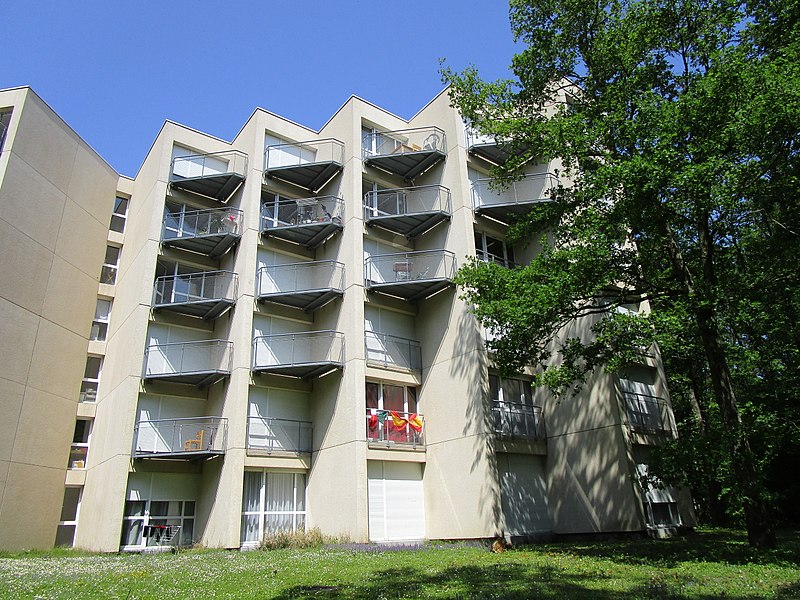
A student residence in Tours (37). Credit: Guillaume 70.
A particularly insightful and interesting ruling clarifies that the non-renewal of several leases within a student residence constituted a partial loss of business goodwill. The ruling was issued by the Third Civil Chamber of the Court of Cassation on February 21.
In doing so, the Court held that the business operated as a student residence by a single operator is not indivisible.
In this case, investors acquired real estate units within a residence comprising 259 units and leased their units to a company engaged in the rental of furnished housing with the provision of hotel-style services.
The co-owners and landlords of 168 units subsequently gave notice of termination to the tenant, without offering renewal and without compensation for eviction, on the grounds of serious and legitimate cause.
The landlords were then sued by the operating company to have the notices of termination declared null and void and to pay eviction compensation.
In support of their claims, the landlords argued that the tenant had sublet their units to students without obtaining their authorization.
The Court ruled in favor of the tenant regarding his claim for eviction compensation, finding that the tenant had simply carried out his commercial activity by signing furnished rental agreements with students, which does not constitute commercial subletting.
Concluding that there were no serious and legitimate grounds for eviction, the landlords are therefore required to pay the tenant the eviction compensation provided for in Article L145-14 of the Commercial Code.
However, the significance of the ruling lies primarily in what follows.
The tenant, in order to calculate the amount of eviction compensation owed to him, argued that the student residence constituted a single operating unit, due to the building’s sole purpose and the fact that the commercial leases were all entered into with a single tenant, and concluded that the loss of a single unit constitutes the tenant’s share of the loss of the business. He therefore requested that the “hotel method” be applied, and that the amount of eviction compensation be calculated based on the total loss of the business based on the average annual revenue over the past three years.
The landlords, for their part, argued that there had been no total loss of the business, but only a partial loss, since not all notices of termination had been issued, meaning the tenant could continue to operate the residence for the remaining units. They argued that the business in question was not comparable to that of the hotel industry, and thus rejected the revenue-based valuation method in favor of the gross operating surplus method.
The Court of Cassation, following the position of the Versailles Court of Appeals, stated in a principle-based ruling:
“However, given that the Court of Appeal had, in its sovereign discretion—in response to the allegedly disregarded arguments—held that the non-renewal of the leases for several units constituted a partial loss of the business and had compensated for the loss of profitability of the remaining business, the Court of Appeal, which thereby rejected the indivisible nature of the business and which, exercising its sovereign discretion, held that the professional practices observed in the hotel industry did not apply to the operation of student housing, set the amount of the eviction compensation using the calculation method it deemed most appropriate and legally justified its decision.”
In residences of this type, there are as many landlords as there are units operated.
Consequently, the amount of the eviction compensation will be calculated not based on the total loss, but only on a portion of the operator’s goodwill, so that this amount will be less substantial for the investor than the amount initially set by the operator.
This ruling is therefore particularly noteworthy, even if its scope remains limited at this time.
It is interesting because the court notes that while the operation of a student residence with hotel-like amenities may resemble that of a furnished hotel, the residence’s operation differs in that a furnished hotel has only one landlord; whereas in residences of this type, there are as many landlords as there are units operated, which can hinder the management of the entire property and even lead to the closure of the residence should all the landlords decide to terminate their leases.
One caveat, however, is that the Court of Cassation appears to have some misunderstanding of how serviced residences operate, in that it upheld the position of the Court of Appeals, which had ruled that landlords who had given notice could transfer their unit to another operator, meaning the residence would be operated by multiple operators at the same time—a scenario that, in reality, is rarely seen in serviced residences.
The ruling’s scope is limited, as it is clear from the statement of principle that only student residences are covered. However, all serviced residences operate on the same model, namely a single operator and multiple co-owners/landlords.
It is highly likely that the Court of Cassation will decide to extend this case law to all serviced residences with a single operator in order to ensure—as we strive to do every day at our firm—that investors’ interests are better taken into account.